Wednesday, February 19, 2014

Conversation Not Going Well?

Over the past two years I have taught several science & religion classes at Stonehill College, participated heavily in the Science in Congregations project, in addition to writing and speaking broadly about the intersection of science and religion. Two things stand out: First, the science-and-religion conversation remains incredibly important. Daily we read stories about "The God Particle," "The God Module in our brains," "The End Times," "Playing God with Genetics," "Death Panels," "The Death of Traditional Marriage," and other topics where the advance of science appears to overrun the tradition terrain of values.

Secondly, this conversation is not going well. Religious belief is often dangerously opposed to mainstream scientific ideas like  Evolution, the Big Bang, Climate Change, and even the vaccination of children.  

There is much to do.


Guest Post: Karl Giberson, PhD

Sunday, February 16, 2014

Challenging the Perceptions (SinC Grantee Guest Blog)

Imagine hearing a church member and research scientist remark, “I often feel more accepted by my non-Christian colleagues in the lab than I do by my fellow church members.” An isolated comment? Not quite.
Funded by the Templeton-sponsored Scientists in Congregations program, our two-year initiative is eliciting several similar comments. Escalating culture wars and the recent election season have expanded the perceived divide between science and Christianity. Too often church members feel they must choose either biblical faith or scientific materialism. We are challenging that perception.
The Scientists in Congregations vision “calls for a sustained, creative collaboration between practitioners in the fields of science (scientists or science educators) and theology / faith practice (pastors) who are already engaged with one another through shared participation in the life of a congregation.” Our large, evangelical mainline church in Boulder, CO, is well-suited for this collaboration. For nearly 140 years we have been neighbors of the University of Colorado, Boulder, where many of our church members are employed in teaching or administration. Many congregants also serve in federal research laboratories or privately owned technology firms. Science fills the air of our rarefied Rocky Mountain region, one of the best-educated portions of the U.S. Our grant seeks to build bridges of listening, learning, and constructive engagement within our church membership and beyond it into our northern Front Range community.
The first bridge is between a pastor and a scientist in the congregation. I am particularly fortunate to have as my grant co-leader a University of California at Berkeley-trained Ph.D. in chemical engineering, an ordained Presbyterian elder who is exceptionally well-read theologically. Allan Harvey is a scientist at the National Institute of Standards and Technology and we have enjoyed many profound conversations about the theological implications of recent scientific discoveries. These have taken us into new ways of interpreting human origins in Genesis, taking into consideration paleontology, cosmology, and the Human Genome Project. We are probing theistic evolution and traditional understandings of the Fall and reflecting on what it means to be made in the image of God. We are tackling concepts like the human soul, free will, and the implications of brain science.
We have recruited a planning team of church members who are climate scientists, geologists, biologists, and physicians. Since a number of church members serve in health care, a large component of our Scientists in Congregations project will include exploration of faith and the health sciences.
We began by hosting focus groups for scientists, learning about their challenges and needs. We moved on to luncheons for both scientists/science educators and physicians/health care practitioners. These informal gatherings allowed us to listen to the concerns they face as Christians in their fields and to offer our thanks for their service in these important areas. As a psychiatrist remarked with enthusiasm, “The church has never done anything like this for us before!”
We have gathered congregational questions on science and faith for inclusion in an FAQ website. A sermon series on Genesis 1-3 explored fresh approaches to these ancient texts. We have hosted a geology field trip that combined worship and devotions with a detailed exploration of Boulder’s striking Flatirons formations. We are planning further field trips led by congregational scientists (for example, in botany and astronomy). In a mutually enriching way, these allow us to wed our faith and appreciation for God’s beautiful creation with solid scientific insights provided by experts in our church.
With a sister congregation in Fort Collins, we have cosponsored a weekend conference combining the teaching of a Christian physicist with a pastor-theologian. The grant allowed us to bus our church members north to this venue to enjoy an all expense-paid day of learning together. Most recently, we have hosted the DVD series “Test of Faith” produced by the Faraday Institute, a group of evangelical scientists in the United Kingdom. This six-week class attracted over 100 participants each Sunday, only half of whom had a background in the sciences.
To date, the Scientists in Congregations program has been well-received by a majority of our congregation. However, some more conservative (and vocal) congregants have voiced their concerns, perceiving this offering as a potential slippery slope into theological compromise and apostasy. As leaders, we have realized there is a necessary pastoral care component to our project; we need to be non-anxious and open to meeting with people to hear and discuss their concerns. Yet at the same time we must stand for what we believe are the complementary aspects of God’s truth expressed both in the Book of Scripture (special revelation read with open minds and the eyes of faith) and the Book of Nature (general revelation studied with the tools of science). In this current climate of division and suspicion, striking this balance is not easy.
It is delightful to watch how this Scientists in Congregations program has spread beyond our church walls. We have been featured in a local newspaper  article and we are noticing that our church members are bringing scientific colleagues and friends from other churches to our gatherings. But most gratifying of all is the quiet, transforming effect this program is having with some who have previously felt alienated by the church. One long-time church member shared these words:

I felt acceptance by the congregation required a closed-minded, simple regurgitation of litanies whether they had meaning or were applicable to life as we currently must live it. I continued to attend sporadically, but out of a sense of spiritual duty, not from joy. I even came to the point of questioning my faith in Christianity and the religious practice of it.... And then I started attending the class on Science and Christianity. Because you were willing to open a dialogue within the church membership about very important and significant things, I feel renewed.... I have not only found that there are many within our congregation who struggle with the same issues as I do, but that we can come to a reasonable, thoughtful reconciliation.

Guest Post: Carl Hofmann

[Bio: Carl Hofmann (M.Div., 1991; D.Min., 2002) is an ordained Presbyterian Church (U.S.A.) pastor serving for the past ten years as associate for spiritual formation and discipleship at the First Presbyterian Church of Boulder, CO. Together with elder Dr. Allan Harvey, they lead the Scientists in Congregations program in their church (http://fpcscienceandfaith.wordpress.com/). Carl is married to Rupali and they have two sons, Jason (18) and Jordan (13).]

Friday, February 14, 2014

Science and the Natural Knowledge of God

We believe in one God the Father Almighty, 
Maker of heaven and earth, of all things visible and invisible.
Nicene Creed

What is the place of a natural knowledge of God? If we can answer this question adequately, we can more properly situate the dialogue of science and theology.

I believe we need to begin with the doctrine of God’s creating the universe and thus

humankind. In these posts, I will argue that God’s creating this world implies that all human beings possess some natural, though vague, knowledge and thus yearning for God.
      
On the way there, it is important to state a basic conviction: This theology must work for the church. I mean that ambiguous phrase in two ways: It must work to make the church better. It must serve the church. Naturally, the most significant representative is Karl Barth’s magisterial Church Dogmatics I/1, which he explicitly inserted the German word kirchliche in the title to his dogmatics (“church” as an adjective) to demonstrate that theology must preach. It has to be kerygmatic. Theology therefore “is a function of the Church.” Put another way, theology must work for the church in that it makes the church a better place. In my reading, too many theologies are written from the perspective of those disdainful of the actual life of Christian communities. In this light, I will present a natural theology, one principally taking in the insights of science, the necessities of the church, and the insights of Scripture.

In working with a type of “creative mutual interaction” that Robert J. Russell sets out within the typology of a Lakatosian “research program,” in Time in Eternity, I am convinced that, in the interaction of science and theology, theology must grasp, then not violate, the insights of science. As John Polkinghorne rightly argues, a scientifically-informed theology demonstrates that we are inherently motivated to believe what is truth and that our beliefs correspond to reality within the framework of critical realism. Simply stated, Polkinghorne argues that theology is “motivated belief.” Put in more traditional language, the Book of Scripture and the Book of Nature have the same Author, and therefore do not contradict one another.
      
In this light, natural knowledge of God provides a key test case for applying scientific insights to theology, not least because scientists (such as the atheist Richard Dawkins) commonly make statements about God’s existence or non-existence. In addition, a natural knowledge of God might be demonstrated, or at least supported, by the insights of science. And finally, the scientific study of nature also flows from a commitment (whether explicit or not) that the world is rational and ordered, which historically has flowed from the confession that God created this world. Charles Townes, in a lecture on the relationship between the Christian faith and modern science, summarizes this connection: 
For successful science of the type we know, we must have faith that the universe is governed by reliable laws and, further, that these laws can be discovered by human inquiry.” 
How then can we bring the insights about the natural world into our doctrine of God as Creator? That is the general tenor of this section. More specifically here, is there a natural knowledge of God, how does that relate to science, and what does this mean for the church? Let me move to some personal experience.

At times in my work as a pastor, and in response to this search for a reasonably intricate theology, I can hear someone reply: “Last weekend, I spent time in the mountains, gazing across a cool, still lake, listening to the wind through the trees. I was able to be silent. In the quiet of nature, I directly encountered God. I learned more about God there than I ever do in a worship service. On Sunday mornings, I hear about God. There I actually touched my Creator.”
      
In many ways, this natural knowledge of God is anti-ecclesial. It poses the question: Why do I need church when I have this direct experience? Why do I need a message from the pulpit when there are “sermons in stones” (to quote William Shakespeare)? From my pastoral experience—and, really, my experience generally—many people, religious or not, find an almost palpable presence of God in creation. And here a few definitions help. In theological language, we enter the realm of general revelation, where God is available “generally,” to all human beings. In many ways, my reflections on the natural knowledge of God constitute a form of general revelation, which also implies God’s benevolence toward all human beings, whether believer or not. As the Gospel of Matthew phrases it (5:45): God “makes his sun rise on the evil and on the good, and sends rain on the righteous and unrighteous.” Theologians contrast it—or complement it—with special revelation, God’s particular acts and communication with the covenant people of Israel and the church. The key point to emphasize is that in either general or special revelation, God is still the One revealing. God is the One who must speak in self-revelation. In this chapter, I will only briefly touch on a related area, natural theology, which takes the data of nature and seeks to build a theological system, and particularly what it means within the critical interaction of science and theology.
      
I find Alister McGrath’s phrase from A Scientific Theology, Volume Isuccinct and profound: "there is an intrinsic capacity within the created order to disclose God." To use Wolfhart Pannenberg's phrase, this creates a "non thematic" relationship to God. This relationship arrives from bearing God’s image, the imago dei (which I will develop in the next section). To use John Calvin’s phrase, it is a sensus divinitatis, or “sense of the divine” (which I will also develop below). This sensus divinitatis provides a background for a more robust and articulated faith in God. It is endemic to human life and therefore an important component toward building a theology for the church informed by science.
      
To be clear, this natural knowledge of God poses a challenge. Here I am responding to this challenge by formulating the proper, useful, and even necessary place for the awareness of God in nature and thus in ourselves (our reflection on nature and our understanding of our own desires), as well as what science has discovered about the natural world. Put with utmost economy of words: A natural awareness of divinity is necessary, but not sufficient, for our understanding of God. In this regard, I am steering a path alongside Calvin’s sensus divinitatis, seeking to avoid Barth’s abhorrence of “natural theology” and of Vatican I’s rather overblown declaration that God can be known with certainty by the natural light of human reason from created things.

(More in the next post, "The Bible and the Natural Theology Knowledge of God.")

Friday, February 7, 2014

The Good News of Being Pro-Science

I know there’s a lot of bad news these days in my denomination, the Presbyterian Church (USA) , but I’m about to deliver some good news.

Presbyterians (and mainline denominations generally) are pro-science, and an anti-science mentality is driving emerging adults away from church.

A few of those pro-science mainline (PCUSA) pastors
I take this to be good news, and I’ll speak personally. I'm Presbyterian pastor with an evangelical-mainline mix, who completed a doctorate in theology with an emphasis on the dialogue with science. As a result, I’ve also taught theology and science in congregations for the past 20 years. And I can affirm there is definitely gospel in bringing together faith and the insights of science.

I’ll say a bit more about my experience in a bit, but let me start with the second part of my sentence above, namely, the problem facing the church: president of the Barna research Group David Kinnaman, in You Lost Me: Why Young Christians Are Leaving the Church, pursued the problem of why our 18-30 year olds don’t seem to find church congregations very interesting or worth their time. Kinnaman specifies, in six chapters, why emerging adults are exiting congregations. One of these is simply titled, “Antiscience.” The Christian church is seen as resisting the findings of science, afraid that they might endanger cherished doctrines. As Mike, one of the subjects of this research, commented, “To be honest, I think that learning about science was the straw that broke the camel’s back. I knew from church I couldn’t believe in both science and God, so that was it. I didn’t believe in God anymore.”

“I couldn’t believe in science and God anymore.” How did Mike come to this conclusion? I’m reasonably sure he learned that outside the PCUSA because I know our denomination boldly engages science. How do I know this? I and another pastoral colleague, David Wood, are wrapping up a $2 million, John Templeton Foundation sponsored-grant, Scientists in Congregations (SinC), which funded 37 congregations in 25 states and 2 other countries to catalyze the dialogue of theology and science in their churches. Despite the fact that we looked for interested parties from any Protestant denomination and the Catholic communion, almost half were PCUSA churches. And I think there are good reasons for this.

First of all, we have some good foundations. The other day I was reading John Calvin’s Institutes of the Christian Religion (as we all ought to do regularly), and I came across this bold sentence from Book II, in a sub-section devoted to the sciences, “If we regard the Spirit of God as the sole fountain of truth, we shall neither reject the truth itself, nor despise it wherever it shall appear, unless we wish to dishonor the Spirit of God.” Stunning! Calvin’s not talking about casually picking up a few scientific facts because they seem interesting; he’s addressing the question of honoring (or dishonoring) God’s Spirit through the way we engage the scientific study of nature.

Secondly, we have some amazing examples. Let me tell you about my experience with four of those congregations that are following Calvin’s dictum and honoring the Spirit by engaging in the truths that science discovers:
  • In addition to an ongoing class on faith and science and a specific fellowship for scientists in their congregation, last fall, First Presbyterian Church of Boulder, Colorado, under the able direction of Carl Hofmann, their associate for education, hosted a conference on health care and faith. The Director of the Center for Spirituality, Theology and Health and of Psychiatry & Behavioral Sciences at Duke University, Harold Koenig, as well as the bestselling author, Philip Yancey, who has a profound interest in faith and science both spoke. 250 attended.
  • St. Andrew’s Presbyterian Church in Houston presented a talk on evolution and the Christian by Kenneth Miller, noted Brown biologist, which proved to be a major outreach to the community nearby. I preached the next day on “Make Me an Instrument of Your Peace,” which a call to reconcile faith and science in our lives, not least because our kids are engaging in science—52% of youth-group teens aspire to science-related careers like biology, chemistry, engineering, technology, as well as medical and health-related careers. My own daughter has just started a program at Barnard College of Columbia University in Neuroscience and Behavior. So I preached with conviction.
  • My own church, Bidwell Presbyterian in Chico, California hosts the Chico Triad, a group of scholars from the two local academic institutions that meets monthly to discuss issues science and faith and presents an annual Science and Religion conference (which will happen in February), with this year’s topic, Science and Scripture. I also teach a yearly course on science, using a book I wrote commissioned by the PCUSA on theology and science, Creation and Last Things: At the Intersection of Theology and Science.
  • One of my favorite stories comes from a smaller PCUSA church in Randolph, New York, which emerged at a conference SinC co-sponsored last May with Fuller Theological Seminary on preaching and science, called “Talk of God, Talk of Science.” When we interviewed our SinC congregations, the team at Randolph, pastor Leslie Latham and scientst Ruth Wahl, commented that, first of all, when they started talking science, the men showed up (who make up only 1/3rd of our PCUSA congregations) and then said something that demonstrated the importance of having scientists who emerge out of the congregation because they have trust: “Oh, it’s Marie. She taught my kids. She’s not going to do anything anti-Christian.”

When we zoom out to the wider world, we realize that the church has not engaged with one of the most important theories that guides scientific inquiry, and which has stood 150 years of scrutiny, the theory of evolution through natural selection. (Need I add that, evolution doesn’t have to embrace Richard Dawkins’s “God doesn’t exist” naturalism?) It’s been a Presbyterian standard for decades that evolutionary science and our confession that God is Creator are compatible: “Neither Scripture, our Confession of Faith, nor our Catechisms, teach the Creation of man by the direct and immediate acts of God so as to exclude the possibility of evolution as a scientific theory.” That’s one of our General Assembly’s “Selected Theological Statements” from 1969. It’s still good 45 years later.

Along those lines, a recent Pew research poll on evolution revealed stunning truths: 60% of the U. S. population believes that human beings and other living things evolved over time. While only 27% of white evangelical Protestants concur, 78% of white mainline Protestants accept evolution in this sense. (I want to add a disclaimer: I’m not sure why Pew focused on “white Protestants,” but that’s what they did. Nevertheless, the numbers are revealing.) My own background—with this combo of a mainline Protestant willingness to dialogue with all forms of knowledge, an evangelical love for Scripture and personal renewal in Christ, and a passion for “mere Christianity” or the “faith once delivered”—leads me to this conclusion: Mainliners must not let go of our engagement with legitimate science as a faithful calling (which the vast majority of our congregants hold to), while the evangelical voice in the PCUSA needs to jettison any refusal to countenance true science and at the same time can keep us all true to the confession of the authority of Scripture and that Christ is Lord and Head of the Church. These strands have deep roots in the PCUSA. 

All together, they qualify as good news for us… and the Church Universal.

Tuesday, January 7, 2014

St. Clive, Scripture, and Science in Congregations

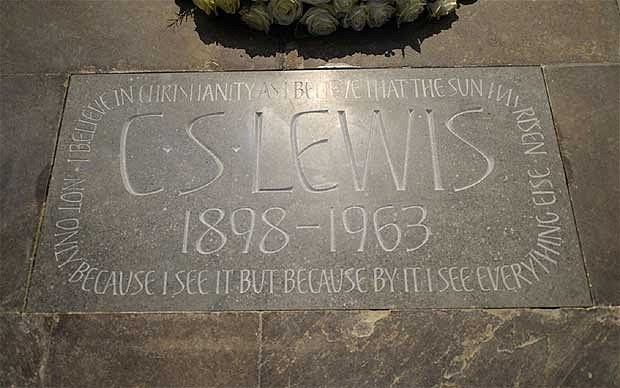
I’ve been reading a lot about Clive Staples Lewis and his take on scripture (and blogging here), while simultaneously co-directing Scientists in Congregations, which encourages church congregations throughout the U. S. to take science seriously. After all, November 2013 marked the fiftieth anniversary of Lewis’s death—and on the 22nd specifically, a memorial was dedicated in his honor in the Poet’s Corner at Westminster Abbey, where he join William Shakespeare, Jane Austen, T. S. Eliot, John Milton, William Wordsworth and the like. This honor for a scholar of the Middle Ages and the Renaissance who dubbed himself a “dinosaur” and yet whose books still sell millions of copies, whose children’s fiction, The Chronicles of Narnia, has its fourth feature film in process, and who was dubbed today’s “hottest theologian” just a few years ago by Time.

For all those reasons and more, I think he’s earned the moniker of “St. Clive.”

For other reasons, I’m pondering these thirty-seven Christian congregations we’ve funded, who represent twenty-five different states, two other countries, eleven denominations, thousands of members, and the gamut along the theological spectrum. They know science is fascinating, powerful, and important, but aren’t convinced, like Richard Dawkins, that science—and particularly Darwin—“made it possible to be an intellectually fulfilled atheist.” They also realize, in order to engage the insights of science, they need to understand their Bible better. Like other Christians, they have a sense—from vague to quite poignant—that the Good Book is crucial for them.

All this brings me to wonder if these two projects could speak to one another, especially around the Bible. Here’s why: Christians that love science also value the Bible, and C. S. Lewis was a world-class Oxford and Cambridge literary scholar who viewed the Bible in a way that is neither truly liberal nor conservative and that allows for both a penetrating engagement with scripture and with science.

Lewis knew how to read a book and prized what books bring. “There is nothing in literature,” Lewis wrote in his famous academic study, The Allegory of Love, “which does not, in some degree, percolate into life.” Consequently, Lewis read the Bible as a literary text (which is certainly not the same as taking the text literally) and sought to find God’s word carried by Scripture. He read the Good Book as full of narratives, meaningful stories, or—as he liked to put it—“myths”… which doesn’t always equal “fiction.” Myth, as Lewis wrote, is “at its best, a real unfocused gleam of divine truth falling on human imagination.” And, as he concluded after a famous 1931 walk with J. R. R. Tolkien and Hugo Dyson, myth became fact in Jesus (which, of course, is recorded in the New Testament).

In that light, Lewis believed the Bible as a book could be read on its own terms and offer legitimate wisdom. Therefore, it didn’t need science to validate its claims. Paradoxically, this may be the best way for congregations that take science seriously as they read their Bibles… in other words, not to suffer unnecessary pains about whether the Bible supports or denies science. Having studied the way churches interact with science over the past two decades—and the thirty-seven congregations we’ve funded—I realize that the Bible often seems outdated because it has not been updated with the most current scientific discoveries. How can we correlate quantum theory and the book of Genesis? Not a particularly pertinent question to Lewis. Science can have a freedom not bound by its corroboration with a specific biblical text. And the Bible, for its part, doesn’t need quantum theory to make it true.

Does Lewis help us today? Many impugn the Bible’s truth because it doesn’t match with the advance of scientific knowledge. It seems outdated and surpassed. In response, we must recall that Lewis never believed that science—nor particularly what he called the “Scientific Outlook”—should be the final arbiter of truth. So he forcefully and consistently argued—in fact, at his vastly popular Oxford Socratic Club, among other places—against science and its norms standing above other forms of knowledge and authorities, such as the ongoing testimony of the church (in the case of scripture).

This means that his understanding of scripture leads to a model of some freedom in its relationship with science and vice versa. Lewis’s approach may at times help Christians avoid pseudo-problems with the Bible when it does not provide, in his words, “impeccable science.” For example, Lewis writes, Genesis 1-2 probably “derived from earlier Semitic stories which were Pagan and mythical,” or as the church Father Jerome put it, was written “after the manner of a popular poet” (thus a myth). And yet, under the guidance of the Father of lights, Lewis concluded that this biblical text became a vehicle for the profound story “which achieves the idea of true Creation and a transcendent Creator.”

Our project has clearly discovered that the Bible and science can and must speak to one another, but these discoveries imply no need to justify the truth of biblical texts against modern science of Big Bang cosmology or evolution, for example. Instead we are free to make connections where they exist. It’s a free interchange without forced agreement or impenetrable conflict.


In the end, Lewis liberates us to read the Bible as a powerful book—one that leads Christians to the center of their faith, Jesus Christ—and to let the liberated study of science also take place. I think that’s something that will take us forward in the discussion and that can help our Scientists in Congregations churches. Maybe that’s one more reason Lewis still speaks today.